
Views: 121 Author: Site Editor Publish Time: 2026-09-07 Origin: Site


If you are comparing paper straw making machines, you will quickly notice that prices can vary significantly even when two machines appear to offer similar production capabilities. The difference usually comes down to what the machine can produce, how fast it can run consistently, how much of the process is automated, and what equipment is actually included in the quotation.

That makes the purchase price useful only when you understand what you are getting for it. You need to compare the complete production capability, not simply the number at the bottom of the quote.
Many commercial paper straw making machines currently sit broadly within the $10,000 to $40,000 range, while some higher-speed or more extensively automated systems can reach $50,000 or more.
These figures are general market benchmarks, not fixed prices. A supplier may also list a lower-cost basic machine or a much more expensive customized line, so the important question is what equipment and production capability the quoted price actually covers.
Machine or Configuration | General Market Position | What Typically Changes the Price |
Standard commercial paper straw machine | Lower to mid range | Production speed and basic automation |
High-speed machine | Mid to upper range | Higher stable output and cutting capability |
More extensively automated machine | Upper range | Automated paper handling, cutting, collection, and controls |
Broader production setup | Varies significantly | Forming machine plus paper preparation, packaging, or supporting equipment |
The price difference usually reflects several production decisions rather than one premium feature. For paper straw manufacturing specifically, speed, automation, cutting, and the range of straws the machine can form have the biggest influence.
A faster machine generally costs more because it has to form, bond, move, cut, and collect more paper tubes over the same period while maintaining acceptable product consistency.
But you need to distinguish between maximum advertised speed and stable production speed.
Maximum speed tells you what the machine can potentially reach. Stable speed tells you what it can maintain during normal production with a particular straw size and material.
For example, this high-speed paper straw making machine has a published maximum speed of 80 meters per minute, while its stated stable operating range is approximately 65 to 75 meters per minute depending on the straw size and material.
For planning production, the stable figure is more useful. If your business model depends on a certain daily output, you need to know what the machine can maintain rather than what it can briefly achieve under favorable conditions.
Automation changes the price because it changes the amount of operator intervention required to keep the line running.
Depending on the model, automatic functions may include paper feeding or paper connection, glue application, glue heating, servo-controlled cutting, straw collection, and centralized digital controls.
That can be valuable when you need continuous production or want to reduce interruptions between different stages. But more automation is not automatically a better investment.
If your production volume is modest and your product range is simple, paying for every available automation feature may add cost without delivering a meaningful return. If you expect long production runs, larger orders, or limited staffing, automated functions may become much more valuable.
You should therefore evaluate automation according to what it removes from the operator's workload and how that affects your actual production plan.
A paper straw machine does not form individual straws one by one. It first creates a continuous paper tube and then cuts that tube into the required lengths.
The cutting system therefore has to keep pace with the forming section.
Machines can differ in the number of cutting blades, cutting speed, synchronization, and the method used to follow the moving tube. A multi-blade system can support high output, but the largest number of blades does not automatically make a machine better.
What matters is whether the cutting system can maintain the required straw length and cut quality at the machine's normal production speed.
If you are comparing two machines, look at the forming speed and cutting capability together rather than judging either specification in isolation.
Paper straw machines also have defined product ranges. Before you compare prices, check whether the machine can actually produce the sizes and paper constructions you intend to sell.
Relevant variables include outer diameter, inner diameter, finished length, number of paper layers, and the grade or thickness of paper being used.
If you only plan to produce one standard drinking straw, your equipment requirements may be relatively straightforward. If you want to manufacture narrow coffee straws, standard beverage straws, smoothie straws, and other diameters on the same line, flexibility becomes much more valuable.
Understanding what the machine does helps explain why two quotations with similar names can differ substantially.
At a basic level, paper straw manufacturing follows this sequence:
Paper feeding → Glue application → Spiral winding → Tube forming → Cutting → Straw collection
A modern machine can combine much of that sequence into one continuous system.
Paper strips are supplied from reels and fed into the forming section. Adhesive is applied between the layers, and the strips are spiral-wound around the forming section to create a continuous tube. Once the tube is sufficiently formed, the online cutting system divides it into individual straw lengths, which are then collected for the next production stage.
Higher-level machines may add automatic paper connection so that a new strip can be introduced with less interruption, controlled glue heating, servo-tracking cutting, and automatic collection.
You do not necessarily need to understand the engineering behind each component when comparing prices. You do need to know which parts of this production sequence the quoted machine handles automatically and which tasks still require additional equipment or manual intervention.
Paper straw machine speed is commonly expressed in meters per minute, but you may be thinking about your business in straws per minute or straws per day.
Those numbers are related, but they are not interchangeable unless you know the straw length.
Imagine two production runs on the same machine. One produces short straws, while the other produces much longer ones. If the machine forms the same total length of paper tube per minute, the shorter product will naturally result in more individual pieces.
That means a supplier quoting only “pieces per minute” should also tell you the straw length used to calculate that figure.
Likewise, a machine rated at 70 meters per minute does not produce one fixed number of straws per minute for every product.
When you compare capacity, make sure you know whether the specification is measured in meters per minute or pieces per minute and what straw dimensions were used.
Possibly, but it depends on how you plan to buy your raw paper.
A paper straw forming machine needs narrow paper strips in the correct widths for the straw construction. You have two basic options: purchase paper that has already been slit to the required widths or buy larger paper rolls and slit them yourself.
Buying ready-slit paper reduces the amount of equipment you need when starting production. You can receive the prepared rolls and feed them directly into the paper straw machine.
In-house slitting adds another production stage and another machine to your budget, but it gives you more control over how the raw paper is prepared. That can become useful when you are operating at larger volumes, working with several paper widths, or want greater control over your material supply.
If you choose that route, make sure the slitting equipment appears separately in the quotation unless the supplier has explicitly included it as part of the complete line.
The forming machine may be the center of your production process, but it is not always the only equipment you need.
Before and during forming, your setup may require paper preparation, an appropriate adhesive system, compressed air, suitable electrical supply, and enough storage and handling space for the raw paper.
The exact requirements depend on the machine design, so you should confirm the utility and auxiliary-equipment requirements before you finalize the order.
You then need to consider what happens after the straw has been formed.
If you intend to sell loose paper straws in bulk, your downstream requirements may be fairly simple. If customers expect individually wrapped straws, counted retail packs, or carton-packed finished products, your production line will need additional handling and packaging equipment.
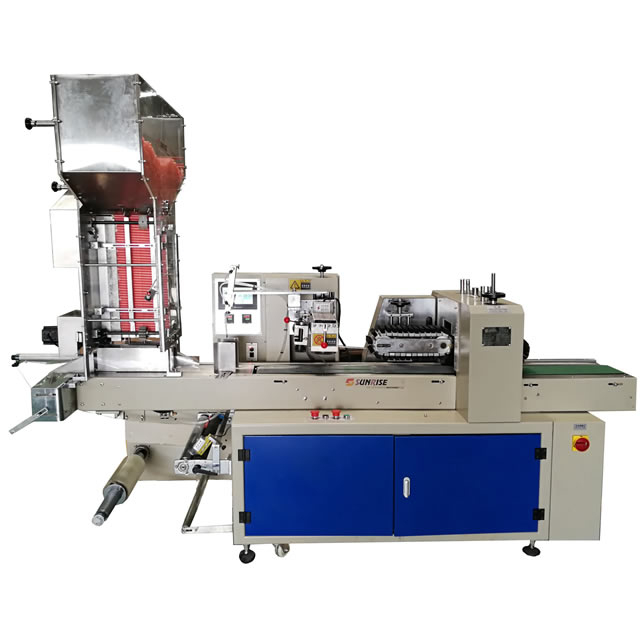
A straw packing machine can handle individual or group packaging depending on the finished format you need. Conveyors, feeding systems, box packing, or specialty processing may also become part of the line.
Your real startup budget extends beyond the equipment purchase price.
A useful way to think about it is:
Machine purchase + supporting equipment + freight and import costs + factory preparation + installation + initial production materials
The exact amount depends on how much of the production process you intend to perform in-house.
Your investment may include the paper straw forming machine, required utilities, adhesive, initial spare parts, freight, installation, and any packaging machinery needed for the finished product.
Because the paper arrives in the required widths, you remove the slitting stage from your initial equipment list.
For a smaller operation or a factory entering paper straw production for the first time, this can simplify both the startup budget and the production layout.
If you buy larger rolls and prepare the paper yourself, you need to add paper slitting equipment, additional material handling, storage, and enough floor space for both stages.
That increases the initial capital requirement, but you gain more control over paper preparation.
Whether the additional investment makes sense depends on your expected volume, raw-material purchasing strategy, and the number of different paper widths you need.
If the straw needs to leave your factory ready for retail, food-service supply, or another customer's production line, you also need to budget for whatever downstream stages that finished product requires.
That may mean individual wrapping, group packing, carton packing, conveyors, automatic feeding, or another specialty process.
Do not plan the factory layout from the machine dimensions alone.
A machine may physically fit into a particular space while still leaving too little room to operate it efficiently.
For example, the LG-P810 itself is approximately 3.5 meters long by 1.5 meters wide, but the recommended working space is considerably larger to provide room for the production process.
You also need space for paper rolls, operator access, adhesive handling, finished-straw collection, maintenance, and safe movement around the equipment.
If you add paper slitting or packaging machinery, the complete footprint grows again. Material needs to move logically from storage through paper preparation, forming, collection, and packaging without creating unnecessary handling or congestion.
By the time you request quotations, you should already know the basic straw you intend to make and which stages you want to perform in-house.
Then you can compare quotations on equivalent production capability rather than price alone.
Check | What to Compare |
Machine price | Exactly what equipment and accessories are included |
Stable production speed | Normal operating output, not only maximum speed |
Speed measurement | m/min or pcs/min and the straw specification used |
Straw diameter range | Whether it covers your planned products |
Paper layers | Supported straw constructions |
Cutting system | Cutting configuration and capacity at production speed |
Automation | Paper handling, gluing, cutting, collection, and controls |
Utilities | Power, compressed air, and other requirements |
Paper preparation | Whether you need separate slitting equipment |
Packaging | Included, optional, or completely separate |
Spare parts | Initial parts supplied and future availability |
Installation and training | What support is included |
Shipping | Freight terms and your responsibilities after dispatch |
Do not assume two quotations are comparable just because they both say “automatic paper straw making machine.”
One may include an automatic paper connection system and collection equipment while another does not. One may quote only the forming machine, while another may include essential auxiliaries. Even two machines with the same stated maximum speed may have different stable operating speeds or straw-size ranges.
Before you choose, make sure you can answer four questions clearly.
Can the machine produce the diameters, lengths, and paper constructions you plan to sell? What stable output can it achieve with those products? Which production stages are included in the quotation? And what else must you purchase before you can make a finished straw?
Those answers tell you far more than the headline price.
A commercial paper straw making machine can represent an investment of tens of thousands of dollars, but machine price alone is a poor basis for comparison. Production speed, automation, cutting capability, straw-size range, paper preparation, and downstream packaging can all change what it actually costs to establish the production capability you need.
Start with the finished straw and work backward. Define its diameter, length, paper construction, expected output, and packaging format, then compare machines that can deliver that specification consistently. From there, you can decide whether ready-slit paper is sufficient, whether you need in-house slitting, and how much downstream equipment belongs in the initial project.
A slightly higher quotation can make more sense if it covers equipment or automation you would otherwise need to add separately. The goal is not simply to buy the cheapest paper straw machine. It is to build the production setup that gives you the right output without paying for capability you do not need.
Many commercial paper straw making machines currently fall broadly within the $10,000 to $40,000 range, while some higher-speed or more extensively automated systems can cost $50,000 or more. Your final quotation depends on production speed, automation, straw-size range, cutting system, and the equipment included.
There is no single pieces-per-minute figure because many paper straw machines are rated in meters of tube produced per minute. The number of individual straws depends on the finished straw length. A machine producing the same number of meters per minute will make more short straws than long ones.
Meters per minute measures how much continuous paper tube the machine forms in one minute. Pieces per minute measures how many individual straws are cut during the same period. You need to know the finished straw length before you can meaningfully compare the two measurements.
Not necessarily. You can buy paper that has already been slit to the widths required by your forming machine. If you want to prepare larger paper rolls in-house, you will need suitable slitting equipment and additional space for paper handling.
The forming machine is the main piece of equipment, but your complete setup may also require paper slitting, adhesive handling, compressed air, conveyors, individual or group packing, carton packing, and other supporting equipment. What you need depends on how your raw paper arrives and how you intend to sell the finished straw.
Check the manufacturer's recommended working area rather than only the machine dimensions. You need additional room for paper rolls, operator access, adhesive handling, finished-straw collection, maintenance, and any slitting or packaging equipment included in the line.


